
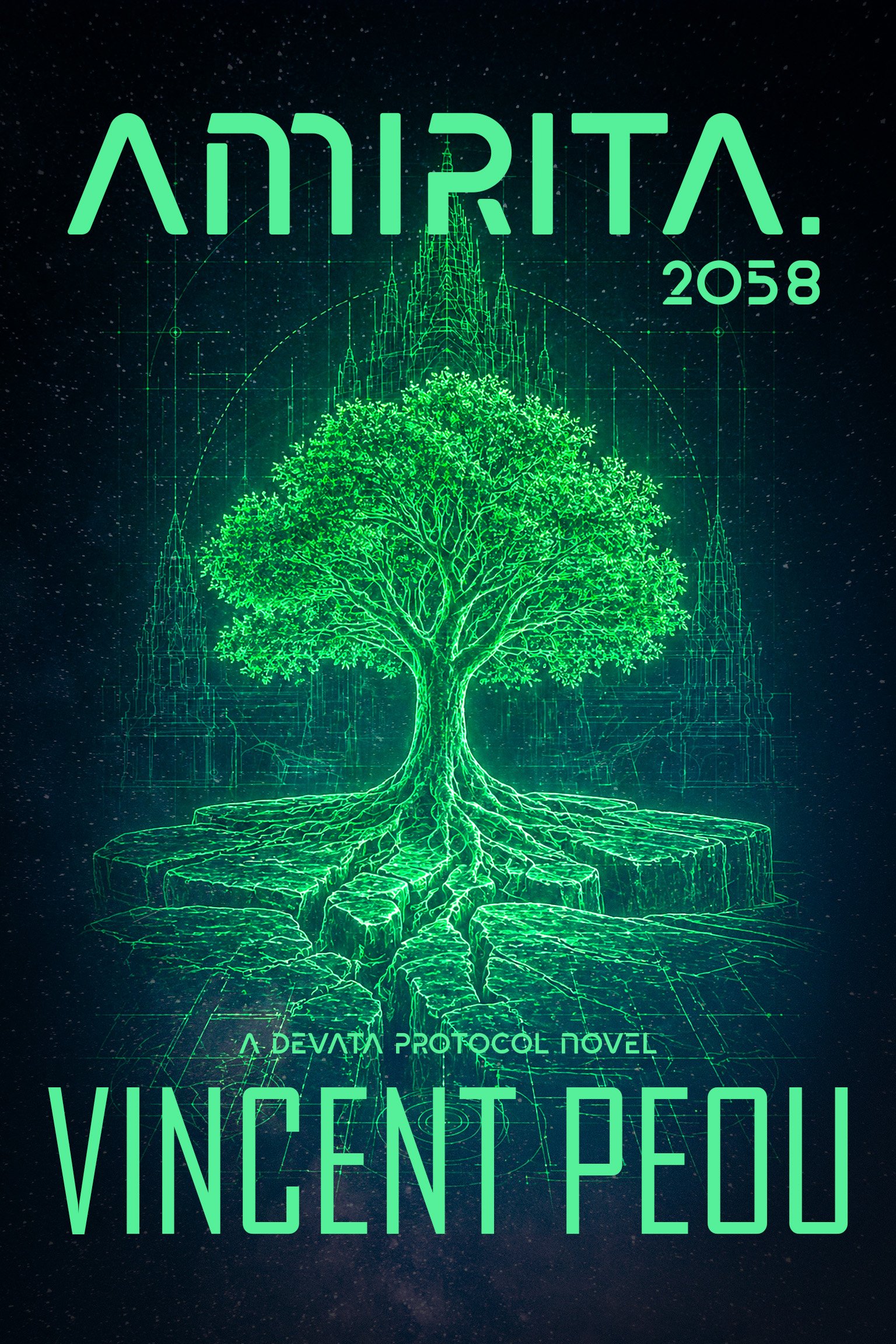
Amirita 2058 is nothing short of a revelation. This is groundbreaking Cambodian science fiction unlike anything the genre has seen before, a story rooted in the soul of Khmer culture and mythology while reaching fearlessly into the future.
Set in a post-apocalyptic Phnom Penh sealed beneath the Apsara Veil, the novel plunges readers into a world divided between the genetically engineered Designed elite and the struggling Naturals, people born of chance in a society that has declared chance itself a crime. At the center of this collision is Kea Ros, a farm boy from Kandal Province whose broken heart becomes the most powerful weapon against a machine civilization built on the premise of perfection.
A Story That Earns Every Emotion
What separates Amirita 2058 from the crowded field of dystopian fiction is its profound emotional authenticity. Peou does not just build a world; he builds a family. The relationship between Kea and his sister Nary is the novel's beating core, a bond that survives genetic classification, years of silence, and the machinery of a totalitarian state. Their reunion in the ruins of their childhood farmhouse is one of the most quietly devastating scenes in recent fiction.
The romance between Kea and Mealea is equally earned, tender, dangerous, and beautifully unconventional. Their first encounter under the stars, trading fence posts like swords in the moonlight, is the kind of scene readers return to long after the book is closed.
Peou renders Phnom Penh with the love of someone who knows its streets and grieves for what they could become.
World-Building Rooted in Khmer Identity
Peou has not simply transplanted a Western cyberpunk aesthetic onto Southeast Asian geography. He has built something genuinely new. The Lotus Spire, the Apsara Veil, the enforcement mechs patrolling heritage-styled lampposts, the Garuda assassins whose name echoes directly from Hindu-Khmer mythology: every detail is specific, purposeful, and culturally alive.
The Russian Market, the ghost of Sinn Sisamouth drifting from a supermarket speaker, the smell of prahok and lemongrass threading through scenes of corporate violence — this is Cambodian science fiction that could only have been written by a Cambodian author, and that specificity is precisely what makes it universal.
Villains of Genuine Complexity
Most impressively, Amirita 2058 refuses easy moral categories. Dr. Arisara and Supreme Chancellor Boran are not cartoon tyrants. They are architects of a terrible logic — visionaries who have confused optimization with humanity. The revelation in the Lotus Spire's final chamber reframes the entire novel and elevates it from action-thriller to genuine philosophical inquiry. The question Peou asks — "What is the cost of a perfect world?" — lingers long after the last page.
Action That Hits Like a Thunderclap
The prologue's introduction of the Garuda is one of the most visceral opening sequences in recent sci-fi. The kill box sequence at the farmhouse, the chaotic battle through the Russian Market, and the final assault on the Lotus Spire are choreographed with cinematic precision and genuine stakes. Peou makes you feel every blade, every heartbeat, every moral compromise.
A New Voice for Southeast Asian Speculative Fiction
Amirita 2058 joins a small but vital tradition of science fiction that centers non-Western voices, non-Western cities, and non-Western futures. It belongs on the same shelf as the best of Afrofuturism and Asian cyberpunk, while standing entirely apart from both.
If you have ever loved Blade Runner, Never Let Me Go, The Handmaid's Tale, or Neuromancer, and if you believe science fiction at its best holds a mirror to who we are and dares us to be better, then Amirita 2058 belongs in your hands immediately.